
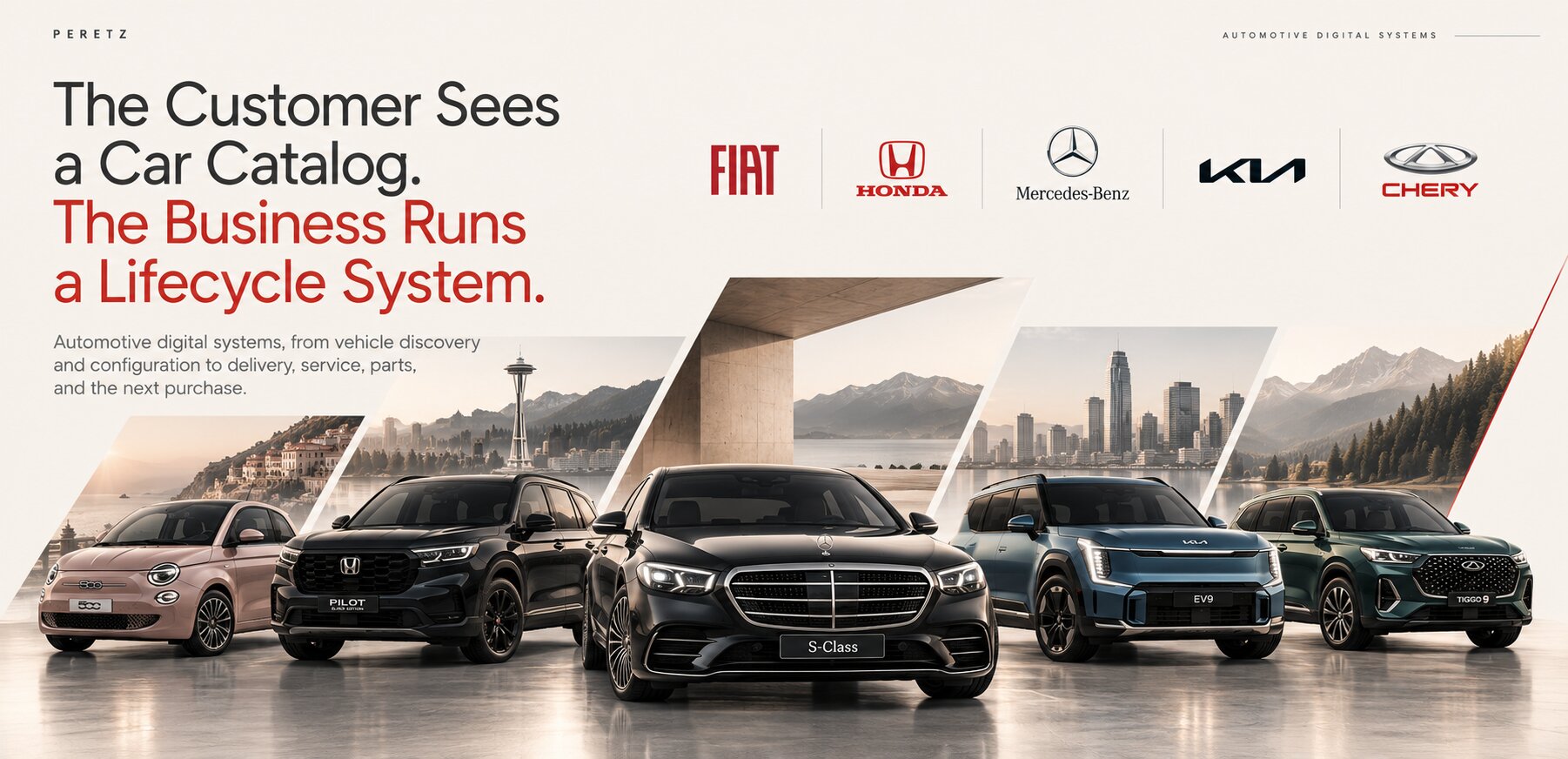
Automotive digital systems, from vehicle discovery and configuration to delivery, service, parts, and the next purchase.
When a customer visits an automotive website, the experience looks deceptively simple. Choose a brand, choose a model, set a few filters, compare configurations, look at available vehicles, choose a dealer, request a quote. It looks like a catalog with a configurator attached to it.
But that is only what the customer sees. Behind that interface is a much larger system connecting vehicle data, configurations, inventory, dealerships, pricing, incentives, financing, trade-ins, CRM, document workflows, delivery, service, parts, and ongoing customer communication.
A normal product catalog describes what a business sells. An automotive digital system has to understand which vehicle exists, where it is, who can sell it, under what conditions, who is buying it, what happens after the sale, and what that relationship should look like years later.
The customer sees a catalog. The business runs a lifecycle system.
CATALOG SURFACE
The Catalog Is Only the Surface
The first mistake in automotive digital projects is to judge complexity by what appears on the screen. The customer sees brand, model, trim, configuration, inventory, as one clean product list. The system has to understand considerably more. A model is not a vehicle. A trim is not a vehicle. A configuration is not necessarily inventory. And a vehicle that appears to be available may already be reserved, sold, in transit, undergoing preparation, or assigned to a particular dealership.
The interface can make all of this look simple. That is the point of good digital architecture, the complexity should be handled by the system rather than passed on to the customer. This is already reflected in modern automotive technology platforms, JD Power, for example, describes its automotive inventory tools as consolidating disparate data feeds from multiple sources to create complete, normalized inventory records. The customer should not have to understand any of that. They should simply be able to find the right vehicle.
A platform we built for Honda Ukraine unified passenger vehicles, motorcycles, marine engines, and power equipment inside one consistent customer surface. Both it and a FIAT dealership platform in Kharkiv, combining passenger and FIAT Professional commercial vehicles, look simple to the customer. Neither is simple underneath.
VEHICLE NOT PRODUCT
A Vehicle Is Not a Normal Product Record
In ordinary e-commerce, a product can often be represented as product, SKU, price, stock. Automotive requires more layers: brand, model, model year or generation, trim, configuration, specific vehicle, VIN. The final step changes everything. A specific VIN refers to an actual physical vehicle, with a particular exterior color, interior, options, mileage, location, dealer, price, and status.
This means an automotive platform has to operate simultaneously as a product information system and an inventory system. The customer sees "2026 Model X." The business may need to distinguish between dozens of individual vehicles that happen to belong to the same model and configuration. That is why automotive inventory cannot simply be treated as another CMS dataset.
CONFIGURATOR RULES ENGINE
The Configurator Is a Rules Engine Disguised as a Filter
The customer may experience a configurator as a pleasant sequence of selections, model, trim, color, interior, options. But underneath the interface, the system has to understand relationships between those choices. Some options are available only with particular trims. Some packages require other packages. Some configurations exist in one market but not another. Some combinations affect price, some affect availability, some affect which specific vehicles can be matched to the customer's request.
So the configurator is not really a filter. It is a rules engine presented as a user interface. A beautiful configurator built on weak product logic becomes difficult to maintain very quickly. A well-designed configurator makes complicated product rules feel almost invisible, which is exactly what a good interface should do.
INVENTORY PRICE LOGIC
Inventory and Price Are Business Logic, Not Fields
An automotive inventory system has to understand states: available, reserved, sold, in transit, in preparation, ready for delivery, delivered. Those states are commercially different. Available does not mean ready. Reserved does not mean sold. Sold does not mean delivered. A customer can be shown a vehicle that exists physically but is not actually purchasable in the same way as another vehicle.
The same inventory record may need to connect vehicle data, dealer, pricing, CRM, website, marketplace, advertising, and the transaction system. The objective is not to create more copies of the inventory, it is to maintain a reliable source of truth and distribute the right representation of that truth to different interfaces. One vehicle, one reliable record, many digital surfaces.
That still leaves an honest question: what happens when systems disagree. The CRM says available, the dealer's DMS says reserved, the website cached yesterday's status. A source of truth isn't enough on its own, it also needs sync timing, conflict handling, and a defined behavior for when a dependent system is running on stale data. In automotive systems, correctness isn't only about where the truth lives. It's also about how quickly every dependent system learns that the truth has changed.
Price follows the same logic. A customer may see one number, but the system may have to consider MSRP, dealer pricing, incentives, regional offers, financing terms, trade-in value, and vehicle-specific adjustments. The real question is never simply what the price of a vehicle is, it's what price and commercial conditions apply to this customer, this vehicle, this dealer, and this transaction right now. Automotive pricing belongs to business logic rather than presentation logic, the website should display the answer, not invent it.
DEALER CHANGES ARCHITECTURE
The Dealer Changes the Architecture
An OEM and a dealer do not have the same digital problem. A manufacturer is concerned with brand experience, model education, product discovery, configuration, campaigns, and the dealer network. A dealer is concerned with local inventory, pricing, leads, sales staff, appointments, financing, trade-ins, delivery, service, parts, and customer history. The manufacturer typically owns the product narrative. The dealer often owns much of the local transaction.
This is the same pattern covered more generally in when e-commerce becomes a business system, different channels sharing one underlying system, not separate businesses that happen to sell the same thing. This distinction is exactly what we've built on both sides of. Honda Ukraine needed a national platform unifying an entire multi-category product range across an authorized dealer network, complete with a dealer locator and centralized CRM and inventory integration. A FIAT dealership in Kharkiv needed the opposite scale, one location's real-time inventory, its own financing calculators, and its own service scheduling, integrated with that dealership's own CRM. The architecture underneath is genuinely different. The discipline that connects them is the same: an automotive website can have a single elegant customer experience while depending on very different sources of data and operational systems underneath.
CONTACT TO RETAILING
From Contact Form to Digital Retailing
A customer clicks "Contact Dealer." It looks like a form submission. From the business perspective, it's a business event. The system needs to know which customer submitted it, which vehicle and VIN they were viewing, which dealer and salesperson should receive it, which campaign produced the lead, what consent was given, and whether the customer already exists in the CRM. A lead without context is much less useful than a lead connected to the complete interaction that produced it. The form itself is easy. The routing logic behind it is the real system.
Digital retailing pushes the transaction further still. A customer may want to configure the vehicle, estimate payments, value a trade-in, apply for financing, upload documents, sign electronically, and schedule delivery, all without a dealership visit. The website gradually becomes one part of an actual transaction rather than a digital brochure, and increasingly there's no clean boundary between where the website ends and the transaction system begins. The website is simply the customer's entry point into the transaction.
SOLD NOT DELIVERED
Sold Is Not Delivered
A vehicle can be sold before it's ready to be delivered. After purchase, the system still needs to coordinate vehicle preparation, documents, payment or funding status, accessories, transportation, the delivery appointment, customer communication, and final handover. The customer's experience might be one sentence, "your vehicle is ready," but that sentence can depend on several systems agreeing that the vehicle actually is ready. Delivery isn't simply another button added to a digital retailing flow. It's another operational state in the lifecycle of the vehicle, and that distinction matters even more once the customer expects home delivery or another coordinated handover experience.
VIN OWNERSHIP KEY
VIN Becomes the Key to the Ownership Experience
The VIN is useful for more than identifying inventory. Once a vehicle belongs to a customer, the VIN becomes the link between customer, vehicle, configuration, warranty, service history, parts compatibility, maintenance schedule, and dealer relationship. That creates a genuinely different digital experience. Instead of asking "which part are you looking for," the system can ask "which vehicle do you own." The customer enters or selects the VIN, the system identifies the vehicle, and it can present compatible parts, relevant service options, and appropriate information. That's fundamentally different from ordinary e-commerce filtering, it's VIN to vehicle identity to compatibility to parts or service.
The interface looks like a parts search. The system underneath knows exactly which vehicle it is talking to.
Both the Honda and FIAT platforms we built put this exact pattern to work, letting a customer search for genuine spare parts using their vehicle's own VIN rather than browsing a generic parts catalog. The interface may still look like a simple product search. The system underneath is doing something considerably more specific.
SERVICE SAME SYSTEM
Service Is Part of the Same Digital System
Service shouldn't live in a completely separate digital universe from sales. The customer who bought a vehicle today may become a service customer tomorrow, and a service appointment adds new information to the same relationship, vehicle, VIN, customer, service event, parts, technician or dealer, history. This is increasingly how automotive technology platforms are being connected, and it's commercially important as well, not just operationally: Cox Automotive's 2026 Fixed Operations and Ownership Study found that customers who return to the dealer for service are substantially more likely to repurchase from that same dealer in the future. Service isn't only an operational function, it's part of the customer relationship.
CRM RELATIONSHIP
CRM Should Remember the Relationship, Not Just the Lead
A dealership CRM that only remembers name, email, lead, deal is remembering the transaction. A more useful system remembers the relationship, the vehicles and VINs a customer owns, purchase history, delivery, service history, parts, warranty, preferences and consent, communications, events, and future purchase opportunities. The system can remember that a customer owns a particular vehicle, has serviced it at the dealership, attended a previous event, and opted into certain communications, and that context lets the business communicate for reasons other than a new lead: a birthday message, a service reminder, an invitation to an owners' event, news about a new generation of the vehicle they already own.
The trigger for that next interaction should come from the customer's actual lifecycle, not a marketing calendar. A VIN combined with mileage or time since last visit can trigger a service reminder on its own. An ownership anniversary can trigger a check-in. A new model matching a customer's current vehicle can trigger an invitation. A dealer event can be matched against eligible owners automatically. A warranty milestone can trigger a relevant, timely communication. The CRM isn't scheduling a campaign, it's observing the state of a relationship and initiating whatever interaction that state actually calls for.
None of that works without also treating channel as part of the relationship, not an afterthought. A service reminder that works as an SMS may fail as an email nobody opens, and which channels a specific customer actually responds to is itself part of what a relationship-first CRM needs to track, not a marketing decision made separately from the customer record. This is the real difference between transactional CRM and relationship CRM, the system stops asking only who might buy something, and starts remembering who this person is, what they own, and what interaction actually makes sense next, the same discipline covered from the systems side in custom CRM vs ERP.
SECURITY IDENTITY
Security and Identity Cross the Whole System
Once all these systems are connected, security stops being a separate feature and becomes an architectural layer across the entire system. The information involved, customer identity, contact information, vehicle ownership, sales history, trade-in and finance details, service history, dealer and inventory data, internal pricing, is sensitive enough that the real question was never whether there's a secure login. It's who is allowed to see what, from which system, under which conditions, and whether that access can be traced. A customer sees their own information, a salesperson sees the customers and deals they're authorized to work with, a dealer administrator needs visibility across a dealership, a dealer group across several locations, an OEM at a different level entirely, and every integration should receive only the data and permissions it actually requires. Security has to exist at the boundaries between systems, not just at the front door, every integration creates another boundary that has to be trusted, controlled, and monitored.
Security is also about limiting what a system is allowed to know, not only what a user is allowed to see. Every API is a boundary too.
That same question, who actually controls access once ownership or vendors change, is exactly what what you own vs what you're renting covers from a broader angle.
A related, less visible problem is identity itself. A customer may appear across the website, CRM, DMS, finance system, service system, event platform, and marketing platform, often under different identifiers, changed emails, or a household sharing a vehicle-related relationship. Customer identity resolution is an architectural problem, not simply a database one, and current automotive platforms are explicitly working toward unified customer identities that connect CRM and DMS history with service visits and past purchases. The customer experiences one relationship. The architecture has to make different systems understand that it's the same one.
Security belongs in the architecture from the beginning. Adding it at the end of an automotive platform project is usually the wrong mental model.
DIFFERENT INTERFACES
Different Interfaces, One Underlying Model
A manufacturer website can focus on brand, product, technology, design, configuration, and model education. A dealer experience can focus on inventory, pricing, appointments, trade-in, financing, delivery, service, and the local relationship. They don't need identical interfaces. They need compatible underlying models, the same principle that appears across strong digital architecture generally: different interfaces do not require different versions of the truth.
CUSTOMER
↓
BRAND / DEALER EXPERIENCE
↓
PRODUCT + VEHICLE DATA
↓
CONFIGURATION + INVENTORY
↓
DEALER / PRICING / INCENTIVES
↓
CRM + DIGITAL RETAILING
↓
FINANCE / TRADE-IN / DOCUMENTS
↓
DELIVERY
↓
SERVICE / PARTS / OWNERSHIP
↓
NEXT PURCHASE
Around all of it: identity, permissions, security, audit. That's the system. The website is simply the part the customer sees, the same architectural discipline covered more broadly in digital architecture.
NOT FROM SCRATCH
Not Everything Has to Be Built From Scratch
An automotive business doesn't necessarily need to replace every existing platform. Mature automotive environments often depend on specialized systems for CRM, DMS, F&I, inventory, service, finance, and parts. The real challenge is deciding what should be the source of truth, what should be integrated, what should be synchronized, what should be exposed through APIs, and what should actually be custom-built. Modern automotive platforms increasingly emphasize connected workflows rather than one monolithic system, Cox Automotive, for instance, describes connected operations spanning trade-in appraisal, CRM, DMS, F&I, and fixed operations as the current direction of the industry. Digital architecture doesn't mean replacing everything. It means deciding how everything should work together, the same calculation covered more broadly in the build vs. buy equation.
BRAND LAYER
The Brand Layer Runs Alongside the System Layer
Everything above describes the operational architecture, catalog, inventory, CRM, service, security. None of it replaces the brand and marketing layer that sits alongside it, campaigns, content, social presence, and the ongoing conversation a brand has with people who don't yet own the vehicle at all.
We've done substantial work on that side too, including social media and brand communication for Mercedes-Benz, KIA, and Chery. That work runs on a different rhythm than the systems described above, campaigns, launches, seasonal content, platform-specific creative, but it feeds the same lifecycle from the other end. Brand and social work brings someone into the funnel. The architecture described in this article is what carries them the rest of the way, through configuration, purchase, delivery, ownership, and eventually back to being ready for the next vehicle. Neither layer replaces the other. A well-run social campaign can fill a pipeline that a fragmented backend then fails to convert, and a technically excellent platform still needs a brand people actually want to engage with in the first place.
SIMPLER EXPERIENCE
The Simpler the Experience, the More Serious the Architecture
This is the paradox of automotive digital design. The customer wants fewer steps, not more. They want to find the car, understand the options, see the price, know whether it's available, choose a dealer, complete the transaction, schedule delivery, book service, find the right part. They don't want to know which internal system supplied each answer, and they shouldn't have to. A successful digital system absorbs that complexity, the architecture becomes more sophisticated so the customer experience can become simpler. That's the actual purpose of all the integration.
The automotive digital experience can look deceptively small, a search field, a configurator, a vehicle page, a dealer locator, a contact button. Underneath may be a system spanning brand, model, trim, configuration, vehicle, VIN, dealer, availability, price, incentives, financing, trade-in, purchase, delivery, service, parts, CRM, relationship, and the cycle doesn't end there. A service reminder, a birthday message, an invitation to an owners' event, news about a new generation of the vehicle they own, eventually a trade-in conversation, then another vehicle, then another delivery. The cycle begins again.
Automotive digital development shouldn't begin with how the dealership website should look. The better question is what the digital system should know, and what it should allow the customer and the business to do across the entire vehicle lifecycle.
The catalog is the interface. The lifecycle is the system.
Why is an automotive website more complex than a typical e-commerce store?
Because a vehicle isn't a normal product record. A single model can represent dozens of physical vehicles with different VINs, configurations, locations, and statuses, and the system has to manage pricing, inventory, and dealer relationships that a standard product-SKU-price-stock model was never built to represent.
Should an OEM and a dealer use the same digital platform?
They need compatible underlying data and business logic, not identical interfaces. An OEM's platform concerns brand and product education across a dealer network, while a dealer's platform concerns local inventory, pricing, and customer relationships, different problems that still need to agree on the same vehicle and customer data underneath.
Does building an automotive platform mean replacing our existing CRM and DMS?
Not usually. Mature automotive businesses typically keep specialized systems for CRM, DMS, F&I, and service, and the real architectural decision is what should integrate with what, not what should be replaced.
How does VIN-based search actually change the customer experience?
Instead of asking a customer to browse a generic parts catalog, the system asks which vehicle they own and identifies compatible parts, service needs, and relevant information automatically, turning what looks like simple search into something considerably more specific to that one vehicle.
Automotive digital systems, whether an OEM-level dealer network, a single dealership platform, or the brand and social layer that fills the pipeline, are what we work on daily. This article was written from direct experience across Honda Ukraine, a FIAT dealership in Kharkiv, and social and brand communication work for Mercedes-Benz, KIA, and Chery.
Talk to Yevhen Borovoi, who leads this work directly.
- Share
-

-

-

-

Related Reading
-
11. 09. 2026
Digital Architecture: How to Build a System That Can Grow With Your Business

-
10. 09. 2026
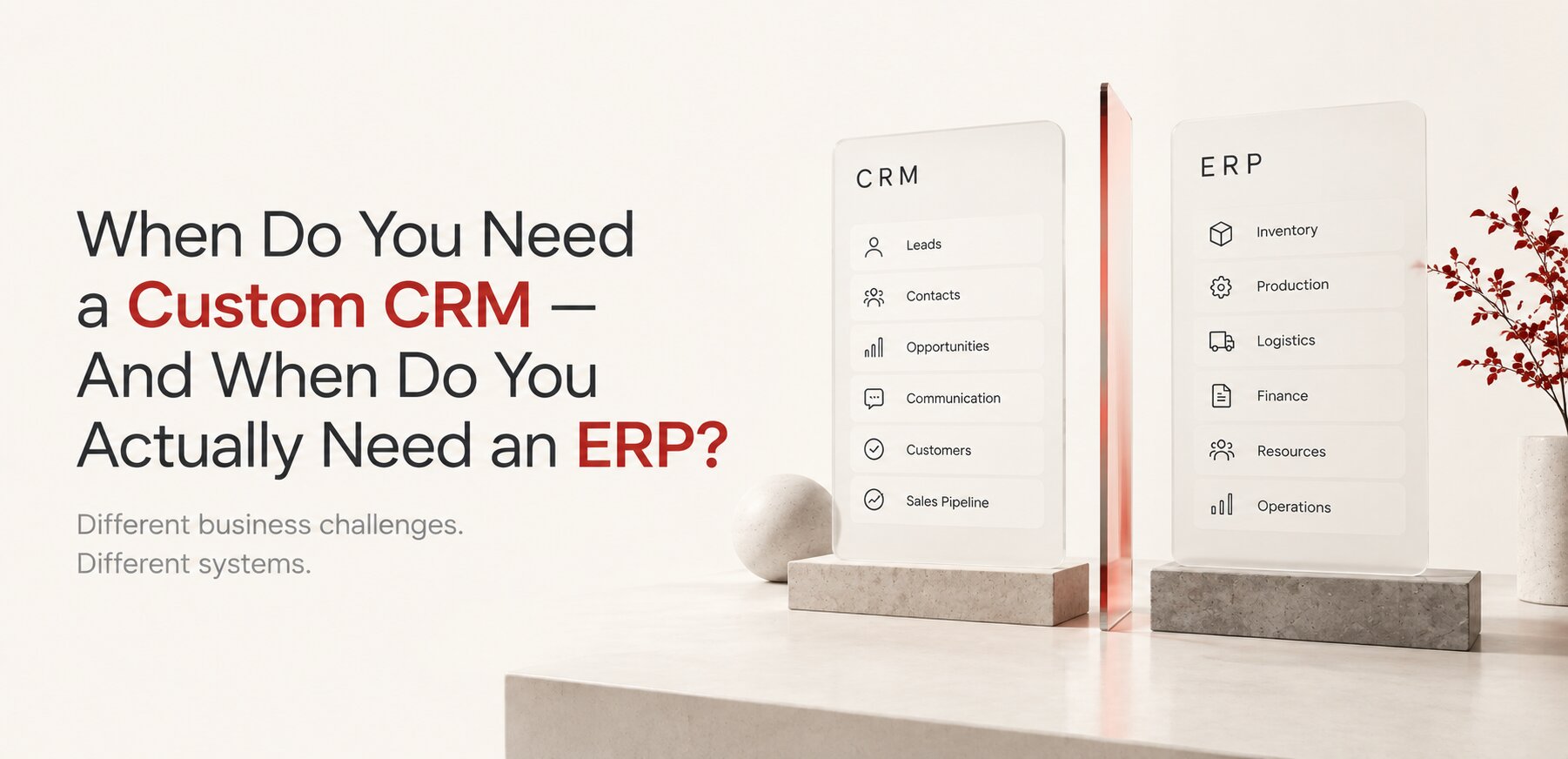
When Do You Need a Custom CRM, and When Do You Actually Need an ERP?
-
16. 09. 2026
What You Own vs What You're Renting: The Digital Ownership Audit
-
17. 07. 2026
The Build vs. Buy Equation Has Changed. Most Companies Have Not Recalculated It.
-
17. 09. 2026
When E-Commerce Becomes a Business System
-
10. 09. 2026
When Do You Need a Custom CRM, and When Do You Actually Need an ERP?
-
16. 09. 2026
What You Own vs What You're Renting: The Digital Ownership Audit
-
17. 07. 2026
The Build vs. Buy Equation Has Changed. Most Companies Have Not Recalculated It.
-
17. 09. 2026
When E-Commerce Becomes a Business System