

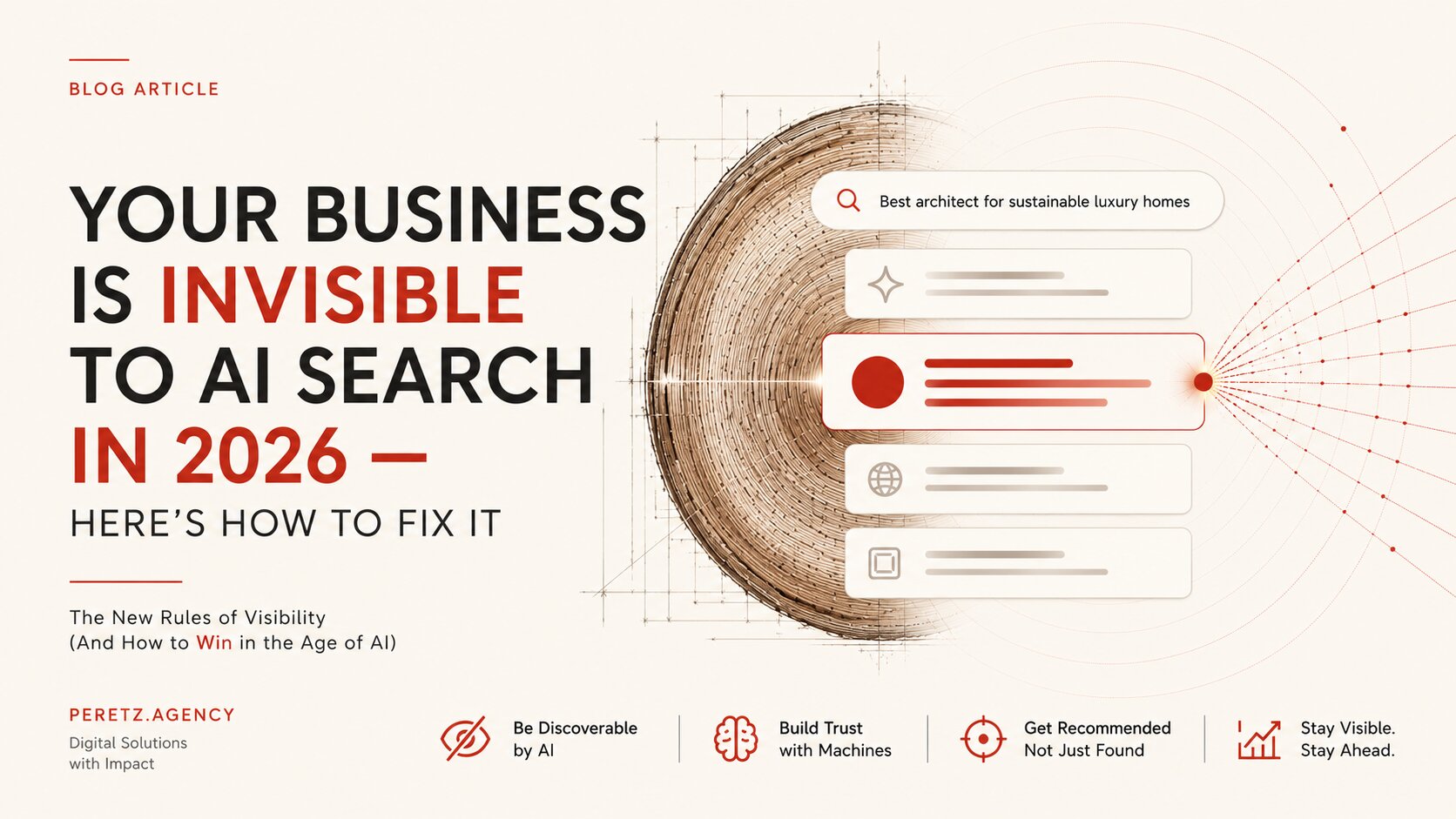
Open ChatGPT right now. Type: 'What's the best digital marketing agency in Seattle?' or 'Where can I find a good SMM specialist for my small business?'
Go ahead. I'll wait.
If your business didn't show up — you have a problem that your current SEO strategy cannot fix. Because this isn't a Google problem. It's an entirely different game with entirely different rules. And right now, most Seattle businesses are sitting it out without even knowing the game started.
The numbers that should wake you up: ChatGPT serves over 800 million weekly active users. Perplexity handles 780 million monthly queries. Google AI Overviews appear in up to 60% of all search results. Traditional organic search traffic is predicted to decline 25% by end of 2026. And AI-referred traffic, while still smaller in volume, converts at 13x higher rates than traditional organic traffic.
Let that last number land. Thirteen times higher conversion rate. Because the person who asks ChatGPT 'best SMM agency Seattle' has already done their thinking. They're ready to hire. They're just waiting to find out who to hire.
If that answer doesn't include you — it includes someone else.
This is a symptom of a bigger pattern: businesses invest in the next channel before diagnosing what's actually blocking growth. We unpacked that pattern in What If You're Solving the Wrong Problem? GEO is a tool. It only works if it's solving the right problem for your business.
What Is GEO and Why You've Never Heard of It (Until Now)
GEO stands for Generative Engine Optimization. It's the practice of making your content visible inside AI-generated answers — not just in traditional search results.
Here's the difference in plain English:
- SEO: You optimize so Google puts your link on page one. Someone clicks, visits your site, maybe buys.
- GEO: You optimize so ChatGPT, Perplexity, or Gemini mentions your business directly in their answer. The user never leaves the AI — but they call you. Or type your name into their browser. Or DM you on Instagram.
The term was formalized in a Princeton University research paper in 2024. By 2026, it's moved from academic concept to survival necessity for any business that depends on search-driven clients.
And Seattle, of all cities, has no excuse to be late to this. You're in the backyard of Amazon, Microsoft, and a thousand AI startups. Your clients are tech-literate. They use AI tools daily. When they need a service — they ask ChatGPT first. Not Google. ChatGPT.
Reality check: Only 11% of domains are cited by both ChatGPT and Perplexity. Your competitor getting cited in one doesn't mean they're in the other. The window to establish AI search presence before it becomes competitive is open right now — but it won't stay open long.
The Old Search vs. The New Search: What Actually Changed
In 2022, someone searching for a marketing agency in Seattle would open Google, see 10 links, click two or three, and decide. You competed for their attention across a page of results.
In 2026, they open ChatGPT or Perplexity and ask: 'I run a small restaurant in Capitol Hill. Who should I hire for social media management?' The AI synthesizes an answer. It might name two or three agencies. It might explain what each one is good at. It might link to their websites.
You're either in that answer or you're not. There's no page two.
This is the structural shift that's happening right now — and it affects every industry differently, but service businesses in Seattle are among the most exposed:
- Clients are already sophisticated AI users
- Service decisions are research-heavy — exactly the query type AI answers best
- Local competition is intense — whoever gets cited first builds a compounding advantage
- The Seattle tech culture means AI adoption is 18–24 months ahead of national average
Do this right now: Open ChatGPT, Perplexity, AND Google's AI Overviews. Type 5 questions your ideal client would ask when looking for businesses like yours. Document which businesses are mentioned. That list is your real competition in 2026 — not the Google page 1 you've been optimizing for.
Why Your Current SEO Isn't Enough Anymore
Before you panic: GEO doesn't replace SEO. It builds on top of it.
But here's the painful truth: a lot of what SEO agencies sold you for the last five years is now table stakes, not differentiation. High domain authority, keyword-optimized blog posts, backlinks from directory sites — these get you into the game. They don't win it anymore.
AI search engines select sources differently than Google ranks them:
- ChatGPT's web search runs on Bing. If you've never submitted your sitemap to Bing Webmaster Tools — you're not even in the pool for ChatGPT citations. Most Seattle businesses have never done this.
- Perplexity is citation-first — it shows sources for every claim. It heavily favors sites with structured, factual content that can be extracted and attributed cleanly.
- Google AI Overviews favor pages with FAQ schema — sites with structured Q&A markup appear 40% more frequently in AI-generated answers for question-based queries.
- All AI systems heavily downweight generic, thin, or AI-generated content without human review and original expertise.
Translation: if your website looks like 200 other agency websites, says the same things in the same way, and has no original data, case studies, or specific expert positions — AI won't cite you. Because AI has nothing differentiating to extract.
The irony: businesses that used AI to generate generic content at scale are now being deprioritized by AI search engines. The Princeton GEO research found that GEO techniques can increase content visibility in AI responses by 30–40%. The prerequisite for those techniques is original, structured, expert-authored content. You can't shortcut your way to AI citation.
The 5 Things AI Search Actually Looks For
I work with businesses across different industries on content strategy and paid campaigns. What I've seen in 2026 is clear: the businesses getting cited by AI have five things in common.
1. Answer-First Structure
AI systems don't read your page like a human. They extract semantic entities from specific content nodes. The first 200 words of any page should directly and completely answer the primary question — no buildup, no brand intro, no 'welcome to our site.'
If someone asks 'how much does social media management cost in Seattle,' your page should answer that in the first paragraph. Not in paragraph nine after you've explained who you are and how long you've been in business.
2. Structured Data (Schema Markup)
FAQ schema — the technical markup that tells AI systems 'this is a question, this is the answer' — increases appearance in AI-generated answers by 40%. Most Seattle business websites have zero structured data. This is a 2-hour technical fix that most businesses have never done.
Beyond FAQ schema: Article schema with author information (real name, real credentials), LocalBusiness schema with accurate NAP data, and Service schema describing what you actually do and who you serve.
3. Real Expertise Signals
AI systems cite sources that can demonstrate genuine expertise. Named authors with real credentials. Original data from actual client work. Specific case studies with measurable outcomes. Opinions strong enough to be citable — not just summaries of what everyone else already says.
This is where most businesses fail the GEO test. They have a website. They don't have a point of view.
4. Cross-Platform Brand Mentions
AI systems don't just read your website. They read the entire web. A business mentioned in local news, industry publications, Reddit threads, and LinkedIn posts builds what GEO practitioners call 'AI share of voice' — the density of your brand across trusted sources that AI systems pull from.
Wikipedia is cited in 47.9% of ChatGPT's top citations. You can't get on Wikipedia (and shouldn't try — it gets removed). But you can get mentioned in industry blogs, local business publications, and community forums where AI systems look.
5. Fresh, Consistent Updates
AI systems that use real-time web search (Perplexity, ChatGPT with browsing) weight recency. A blog post from 2021 is not a GEO asset in 2026, even if it ranks on Google. You need content updated in the last 6–12 months, with dates visible, by named authors.
Quick GEO audit for your business: Go to your website. Can you answer yes to all of these? (1) Every service page answers the main client question in the first paragraph. (2) You have FAQ schema on your key pages. (3) Every blog post has a named author with credentials. (4) You've submitted your sitemap to Bing Webmaster Tools. (5) Your last published piece of content is under 6 months old. If you got fewer than 3 yeses — you have work to do.
The Seattle Angle: Why This Matters More Here Than Anywhere
I work with businesses in multiple markets. Seattle is different.
Your clients are not average American consumers. They work at Microsoft, Amazon, Boeing, and a thousand startups and spinoffs. They use AI tools professionally. They're not asking Google 'marketing agency near me' — they're asking ChatGPT with a three-paragraph description of exactly what they need and asking for ranked recommendations with reasoning.
That's the query your business needs to be ready to answer. Not a 2-word keyword.
The good news: most Seattle businesses haven't figured this out yet. The local SEO market is sophisticated on traditional metrics — domain authority, local citations, reviews — but almost nobody is doing serious GEO work. The competitive window is open.
The bad news: the window closes as awareness grows. Every month you wait, a competitor who moves first compounds their AI citation advantage. AI systems learn from data and build patterns over time.
What to Do This Month (The Practical Checklist)
This isn't theory. Here's what actually moves the needle:
- Week 1: Submit your sitemap to Bing Webmaster Tools. Free. 20 minutes. Non-negotiable for ChatGPT visibility.
- Week 1: Run your top 10 client queries through ChatGPT, Perplexity, and Google AI Overviews. Screenshot everything. This is your baseline.
- Week 2: Restructure your top 3 service pages. First paragraph answers the main question directly. Add an FAQ section with 5–8 real questions your clients ask. Implement FAQ schema.
- Week 2: Make sure every page has a named author with a real bio and credentials. 'The Peretz Agency Team' is not an author. Iryna Nechaeva, Marketing Strategist, is.
- Week 3: Publish one piece of deeply specific, data-rich content about your local market. Not 'top 10 tips for social media.' Something like: 'What Seattle restaurants actually spend on social media management in 2026 — and what they get for it.'
- Week 3: Build brand mentions off-site. Reach out to 3 local business publications or industry blogs. Offer a specific data point or opinion piece. One mention in a trusted local source is worth more for GEO than ten blog posts on your own site.
- Week 4: Re-run your query audit. Compare results. Where did you gain? Where are competitors still dominating? Prioritize the next content cycle around those gaps.
The compounding effect: GEO is not a one-time fix. It's a system. Every piece of cited content increases your AI share of voice. Every citation builds authority signals that make the next citation more likely. The businesses starting this in mid-2026 will have a structural advantage by 2027 that cannot be bought overnight.
This Is Exactly What We Do at Peretz Agency
I'm not writing this from theory. I manage content strategy and paid campaigns for clients across multiple markets, and I've watched the shift happen in real time.
At Peretz Agency, we combine what most agencies separate: Yevhen Borovoi handles web architecture and technical implementation — schema markup, site structure, Bing optimization, page speed. I handle content strategy, social media, and paid amplification that builds the off-site brand signals AI systems read.
Together, that's the full GEO picture: technical foundation + content authority + social proof. You can't have one without the others and expect results.
What we do for clients specifically:
- GEO audit: Where are you currently cited (or not) across ChatGPT, Perplexity, and Google AI Overviews?
- Technical foundation: Bing indexing, schema markup implementation, site structure for AI extractability
- Content strategy: Topic clusters and content architecture designed to earn AI citations, not just Google rankings
- Off-site brand signal building: Local publications, industry mentions, structured community presence
- Paid amplification: Meta and Google Ads that drive traffic while your organic GEO authority builds
- Monthly tracking: Citation share across AI platforms, not just keyword rankings
Curious where your Seattle business stands in AI search right now? Contact us at hello@peretz.agency or call +1 425 471 94 96. We'll run a live GEO audit in front of you — 30 minutes, no pitch, just your actual AI visibility data.
The Uncomfortable Prediction
By the end of 2026, traditional organic search traffic is projected to decline 25% as users migrate to AI-powered interfaces. That decline is not evenly distributed. Informational and commercial research queries — exactly the searches that bring clients to service businesses — are migrating fastest.
In three years, 'rank on Google' will sound like 'rank in the Yellow Pages' sounds today. Necessary? Probably still useful at the margins. Sufficient? Not even close.
The businesses that will dominate Seattle's service economy in 2028 are the ones who start building AI search presence in 2026. Not because they predicted the future perfectly. But because they saw the wave coming and got in the water before it arrived.
The wave is here. The question is whether you're paddling or still reading about it.
Author: Iryna Nechaeva — Marketing Strategist | SMM Specialist | Targetologist at Peretz Agency
CTA: Run Your Free GEO Audit → hello@peretz.agency | +1 425 471 94 96
What to do about it on the commerce side, once visibility exists, is set out in SEO Gets You Found. AEO Gets You Recommended. Your Commerce Infrastructure Gets You Bought..
For businesses serving customers in more than English, see multilingual AEO, since this same invisibility problem often exists separately in each other language too.
- Share
-

-

-

-

Related Reading
-
19. 06. 2026
How Much Does Social Media Management Cost in the US in 2026?

-
17. 06. 2026
Why Your Business Isn't Getting Leads From Its Website (And How to Fix It in 2026)
-
23. 06. 2026
Why Most Businesses Are Using AI Wrong in Marketing — And It's Killing Their Conversions
-
14. 02. 2021
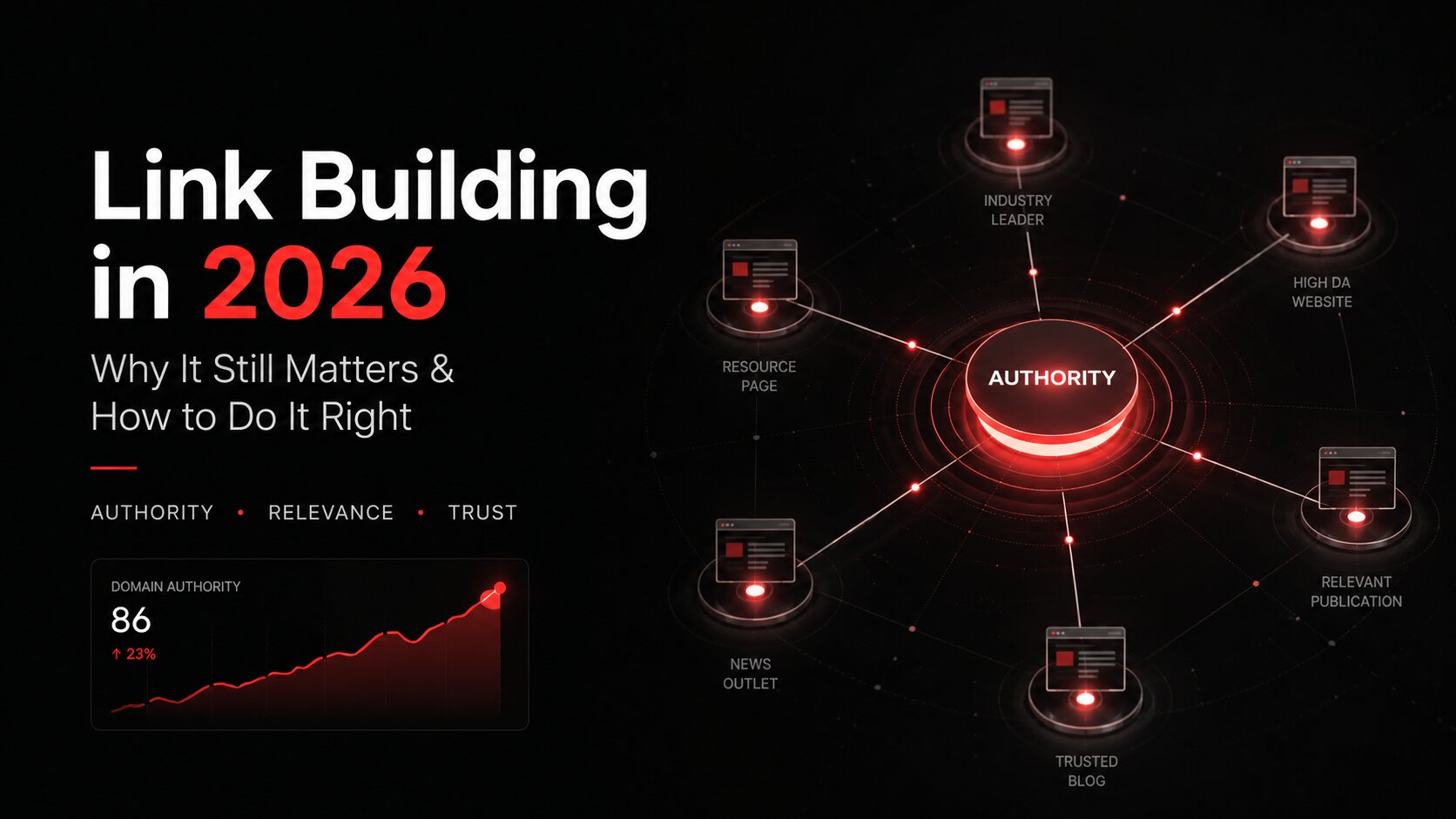
Link Building in 2026: Why It Still Matters and How to Do It Right
-
30. 06. 2026

I Audited 50 Instagram Accounts This Year. Here's What Actually Separates Growth from Stagnation.
-
07. 07. 2026
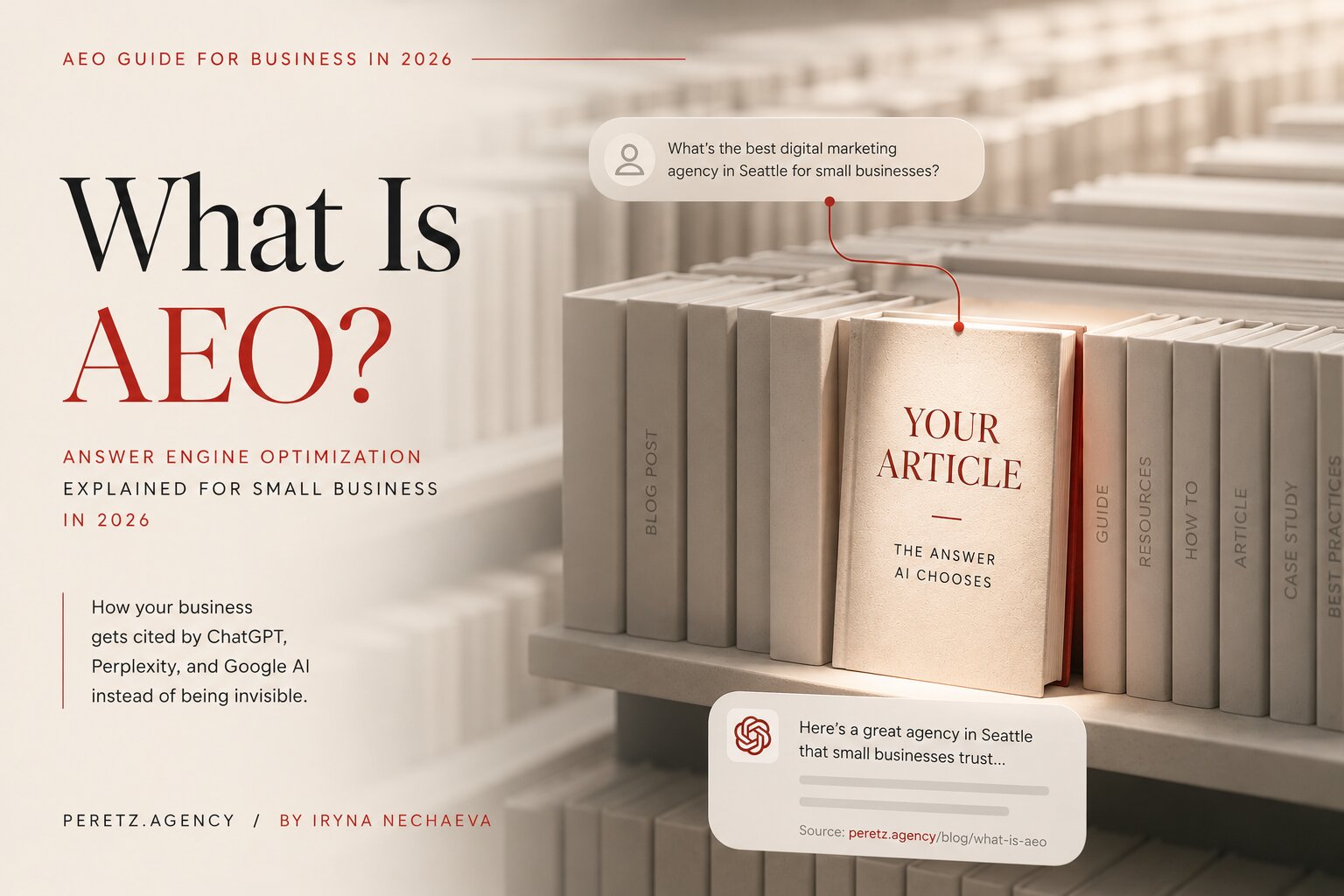
What Is AEO? Answer Engine Optimization Explained for Small Business in 2026
-
31. 07. 2026

We Design for Reality, Not for Ideal Scenarios
-
05. 08. 2026

Your Business Doesn't Go Live. It Comes Alive.
-
17. 08. 2026

When Everyone Can Publish 500 Articles, What Is Content Worth?
-
24. 07. 2026

What If You're Solving the Wrong Problem?
-
06. 09. 2026

SEO Gets You Found. AEO Gets You Recommended. Your Commerce Infrastructure Gets You Bought.
-
17. 06. 2026
Why Your Business Isn't Getting Leads From Its Website (And How to Fix It in 2026)
-
16. 09. 2026
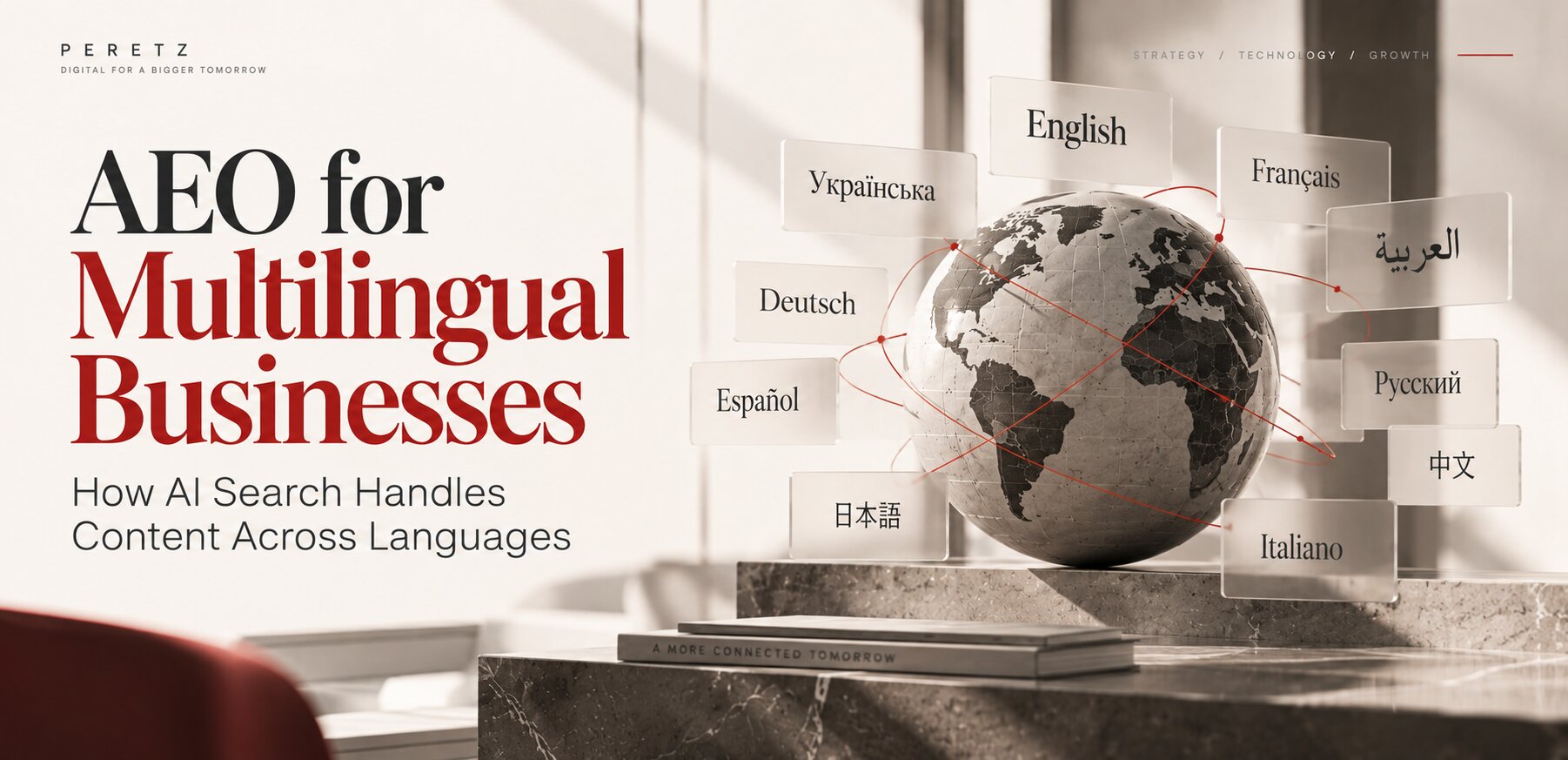
Multilingual AEO: Why Translation Isn't Enough for AI Search