
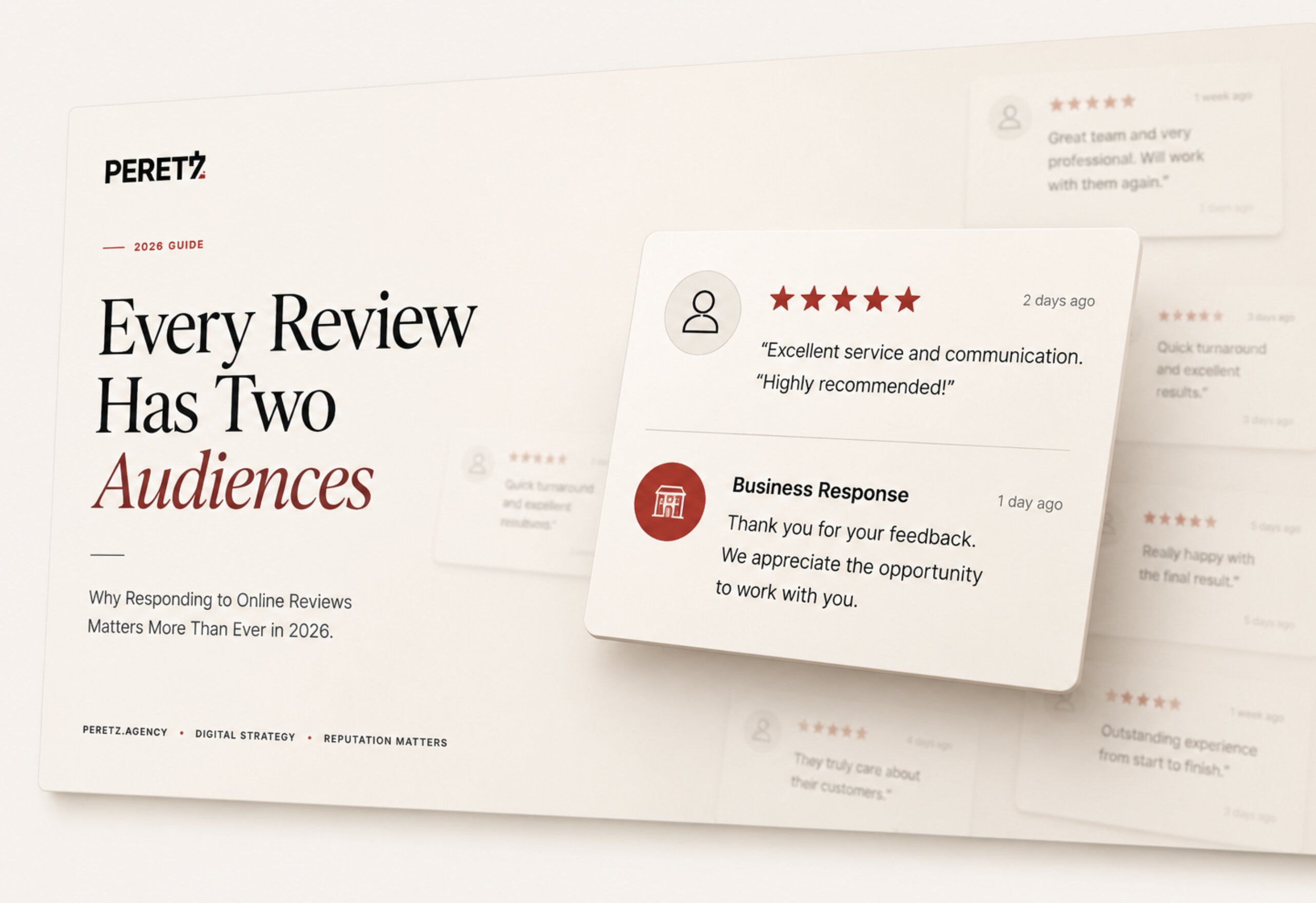
If someone discovers your business today, there’s a good chance they’ll read your reviews before they visit your website.
Whether they’re searching on Google, Yelp, Facebook, Trustpilot, Clutch, Houzz, or Angi, reviews have become one of the most influential factors in the buying process.
But here’s something many businesses still overlook:
Every review has two audiences.
The first is the customer who wrote it.
The second is everyone else who reads it.
And in 2026, that second audience often matters even more.
PUBLIC CONVERSATIONS
Reviews Are Public Conversations
Many business owners treat reviews as ratings.
Customers see them differently.
Reviews are conversations.
When a potential client reads your reviews, they’re not only evaluating what previous customers said. They’re evaluating how your business responds.
A thoughtful response demonstrates:
- professionalism
- accountability
- communication skills
- customer care
Ignoring reviews sends a message too — and it’s rarely the right one.
LOCAL SEO
Reviews Influence Local SEO
Online reviews are an important part of local search visibility.
Search engines use signals such as:
- review quantity
- review freshness
- review diversity
- overall rating
- business activity
While responses alone won’t guarantee higher rankings, businesses that actively engage with customers tend to maintain stronger and more trustworthy local profiles.
For local businesses in Seattle, Bellevue, Tacoma, Kent, or anywhere in Washington State, that visibility can directly impact lead generation.
AI SEARCH
AI Search Is Changing How People Discover Businesses
In 2026, customers aren’t only using Google.
Many are asking AI assistants questions like:
- “Who is the best web design agency in Seattle?”
- “What contractor has the best reviews near me?”
- “Which marketing agency has the strongest reputation?”
AI-powered search systems increasingly analyze publicly available information, including reviews, ratings, and brand mentions.
Your online reputation is no longer just for human readers.
It’s becoming part of how AI systems understand and recommend businesses. What else AI search looks at, and how to make your business visible to it, is covered in Your Business Is Invisible to AI Search in 2026.
POSITIVE REVIEWS
Why Positive Reviews Deserve a Response
One of the biggest mistakes businesses make is only responding to complaints.
Positive reviews deserve attention too.
Bad response:
Thanks!
Better response:
Thank you for your feedback, John. We enjoyed working on your website redesign project and appreciate your trust in our team.
Personalized responses show authenticity and reinforce customer relationships.
They also demonstrate to future customers that real people stand behind the business.
A simple structure keeps every reply personal without starting from a blank page:
- Greet the person by name. It is a small courtesy, and it shows a human is reading.
- Thank them specifically. Mention what they actually said, not just “thanks for the review.”
- Highlight one thing that matters to your brand. A detailed review is a chance to underline a real strength for everyone else reading.
- Invite them back, lightly. Optional, but a natural close: a new collection, a follow-up service, or simply “see you next time.”
Here is how step three works in practice. Say you run an online clothing store and Natalie writes: “The suit arrived today and it fits perfectly. The fabric feels amazing, I will probably live in it for a week. Thanks for shipping so fast!”
If fabric is what sets you apart, your reply can quietly make that point:
Hi Natalie, thank you for sharing this, it genuinely matters to the team. We are especially glad you love the fabric: we spent almost a year searching for exactly this one. Enjoy wearing it, and we are here whenever you need us.
Every future customer who reads that exchange learns something true about your product, from a voice that is not an ad.
NEGATIVE REVIEWS
How to Respond to Negative Reviews Professionally
Negative reviews can feel frustrating.
However, how you respond often matters more than the review itself.
A professional response should:
- acknowledge the concern
- remain respectful
- offer a solution
- move the discussion offline when appropriate
Example:
Thank you for bringing this to our attention. We’re sorry your experience didn’t meet expectations. We’d appreciate the opportunity to discuss this directly and find a solution.
Avoid:
- arguing
- blaming customers
- becoming defensive
- posting emotional responses
Remember: future customers are reading your reply.
The first instinct with a negative review is often to delete it or ignore it. Resist both. A complaint answered quickly and honestly often earns more loyalty than a perfect rating, while silence lets one bad experience snowball.
Reply publicly first, even if the details need a private conversation. A short public answer shows everyone that you took the problem seriously, and the specifics can continue in a direct message. If the customer is right, say so and fix it. Owning a mistake in public is one of the fastest ways a brand earns trust.
FAKE REVIEWS
What to Do About Fake Reviews
Not every negative review comes from a real customer. Competitors, former employees and, occasionally, bots leave reviews too.
- Check the profile first. Fake accounts often have no photo, no history and no other reviews, or a burst of reviews posted on the same day.
- Reply calmly anyway. Do not accuse anyone publicly. Thank them, say you cannot find their order, and ask for details such as an order number or a date. A real customer usually answers; a fake one rarely does.
- Report it to the platform. Google, Yelp and most review sites let you flag reviews that break their policies, such as fake engagement or a conflict of interest. Report it once, keep a record, and let your public reply do the rest.
Handled this way, even a fake review becomes proof that your business responds with composure.
BIGGEST MISTAKE
The Biggest Review Management Mistake
Most businesses respond only when something goes wrong.
Strong brands respond consistently.
Whether the review is positive, neutral, or negative, engagement shows that customer feedback matters.
Consistency builds trust.
Trust builds conversions.
BEST PRACTICES
Best Practices for Responding to Reviews in 2026
To maximize the value of your reviews:
- respond within a few days whenever possible
- personalize every response
- thank customers for their feedback
- address concerns professionally
- avoid generic templates
- monitor multiple review platforms
- encourage satisfied customers to leave reviews
The goal isn’t simply to reply.
The goal is to demonstrate credibility.
FINAL THOUGHTS
Final Thoughts
Online reviews are no longer just social proof.
In 2026, they influence:
- customer trust
- local SEO visibility
- AI-driven discovery
- lead generation
- conversion rates
Every review is a public conversation about your business.
And every response is an opportunity to strengthen your reputation.
The businesses that understand this will continue to earn trust long before a customer ever reaches their website.
- Share
-

-

-

-

Related Reading
-
24. 11. 2020

7 UX/UI Design Trends That Actually Matter in 2026

-
14. 02. 2021
Link Building in 2026: What Works and What Doesn’t
-
02. 12. 2020
Redesign of Sports Online Store Sport Discount
-
30. 11. 2020

The case of Laduchi
-
20. 12. 2020
Why Your E-Commerce Store Needs a Blog in 2026 — And How to Start One That Actually Works
-
14. 02. 2021
Link Building in 2026: Why It Still Matters and How to Do It Right
-
19. 06. 2026

How Much Does Social Media Management Cost in the US in 2026?
-
19. 06. 2026
Business Process Automation in Kirkland: What Digitalization Actually Means (And When You Need It)
-
25. 06. 2026
Website Redesign vs New Website: How to Make the Right Decision in 2026
-
29. 06. 2026

Meta Ads in 2026: What Budget Do You Really Need to See Results?
-
02. 07. 2026
TikTok vs Instagram for Small Business in 2026: What the Data (and My Clients) Actually Show
-
02. 07. 2026

I've Rebuilt My Career Twice Because of War. Here's What That Actually Teaches You About Strategy.