


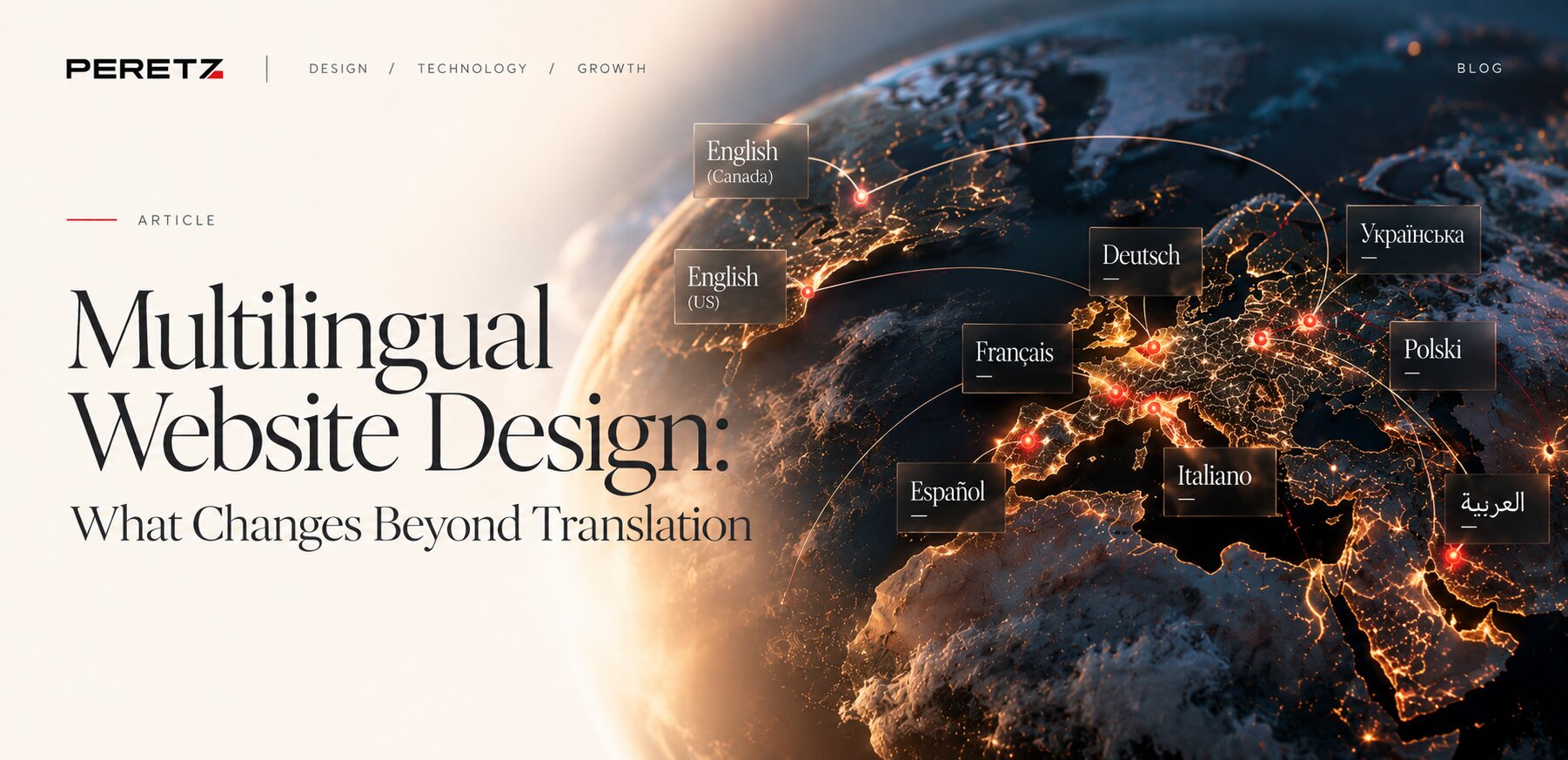
A multilingual website is several sites that share a structure. What changes from one version to the next goes far beyond the words.
SHORT ANSWER
What Is Multilingual Website Design?
Multilingual website design is adapting one site to several languages and markets: the content, layout, typography, imagery, navigation and business rules change for each audience, while the structure and the brand stay consistent. Translation is one layer of that work. A page that reads well in English may need a different headline, different examples or a different banner before it works for a reader in Warsaw, and a mirrored layout before it works in Dubai.
It helps to separate three things that are often treated as one. A language version is the site in another language. A regional version is a language adapted to a particular country, such as Arabic for the United Arab Emirates. A market is a country or group of customers with its own prices, taxes, delivery and expectations. One language can serve several markets, and one market can need several languages.
We have designed and built many sites in three or more languages, among them SV Group, the Institute of Trichology, DeZZign, Affalina, Nico Juliany, Nicole, IFHRS and Medpresso, which runs in four. Our own site is published in English, Russian and Ukrainian, and Schoeffel, a pearl house whose new site is in development, will run in about ten languages, including Chinese and Arabic. Across these projects, the same layers change:
| Layer | What changes | Example |
|---|---|---|
| Content | Headlines, arguments, case studies and success metrics chosen for each market | The case that convinces a buyer in one country may mean little in another |
| Layout | Text length, line breaks, reading direction | An Arabic version mirrors the page from right to left |
| Typography | Fonts that support each script, sizes, line spacing | Cyrillic, Arabic and Chinese each need fonts designed for them |
| Imagery | Banners, photographs and, in some markets, the logo | Visuals adjusted to the cultural norms of the audience |
| Navigation | How visitors choose or receive their version | A region selector, a default language or a switcher on every page |
| Business rules | Prices, currency, taxes, delivery, payments, instalments | A store sells under different rules in each country |
| Search | Separate addresses, hreflang tags, titles and descriptions per version | /ru/ and /ua/ versions with their own meta data |
MARKETS
Each Market Reads the Page Differently
The most common mistake is to treat the second language as a copy of the first. On Medpresso and on Schoeffel, the headlines, the case studies, the metrics we chose to show and even the way the main question was framed differ from one market to another, because each market has a different focus. A visitor in the United States and a visitor in Poland may look at the same offer and judge it by different evidence, so a page that answers one of them well can leave the other unconvinced.
Banners show this most clearly. A banner usually carries a promise, and a promise that works in one culture can sound exaggerated or irrelevant in another. On many of our projects the banners and their message are redesigned for each version, and the change goes well beyond replacing the text inside them.
This is where translation, localisation and transcreation part ways. Translation carries the meaning across. Localisation adapts formats, units, examples and references to the market. Transcreation rewrites a message so that it has the same effect on a different audience. Most sites need a mix, and the right level depends on the job of the page and the risk of getting it wrong: a home page headline may need transcreation, a product page usually needs localisation, and a legal page may need review by a local lawyer rather than just a translator.
The search side follows the same logic. We explain why translated pages often fail to rank in multilingual SEO: why translated pages don't rank, and why translation alone does not help with AI assistants either in multilingual AEO.
SCRIPTS
Arabic and Chinese
Adding another European language usually means adjusting an existing layout. In our projects, Arabic and Chinese have required a separate design, with different layouts, front-end work and priorities on the page.
Arabic is written from right to left, so the interface has to be mirrored: navigation, the order of columns, the direction of arrows and sliders, the position of icons next to text and the logic of forms all change. Numbers, Latin brand names and product codes still run left to right inside Arabic text, and the design has to handle that mix. Chinese has its own typographic rhythm: characters are denser, line length and spacing work differently, and a layout built around English word lengths rarely transfers unchanged. Both scripts need fonts designed for them, and a typeface that looks refined in Latin may have no matching Arabic or Chinese version at all.
Culture reaches further than script. For Schoeffel's Arabic-speaking markets even the logo had to change: the pearl diver in the emblem is now dressed in a garment similar to a sarong, so that the brand does not show nudity to an audience for whom that would be inappropriate.
In Arabic, even the logo had to change.
SWITCHER
How Visitors Reach Their Version
There is no single correct way to send a visitor to the right version. We choose the approach for each project based on where its main market is and how clearly its markets are separated. In practice we use three:
- A region and language selector on the first visit, when the brand sells in several countries with different prices, delivery or ranges.
- A default language set by the main market, English for a business focused on the United States or Ukrainian for one whose clients are mostly in Ukraine, with a switcher always visible.
- A suggested version based on the visitor's location, when markets are clearly separated.
The third approach needs care. Google's guidance for multilingual sites advises against automatically redirecting users from one language version to another based on assumptions about their language, and describes IP location analysis as generally unreliable. Googlebot usually crawls from the United States and does not send a preferred language, so a site that redirects by IP without offering a choice can hide its other versions from search. Whatever the approach, every page should link to its equivalents in the other languages, and the visitor should always be able to change the choice.
Behind the switcher sits the structure search engines rely on: a separate address for each version (on our own site, subdirectories such as /ru/ and /ua/), hreflang tags that tell Google which pages are equivalents, and titles and descriptions written for each language.
STORES
Stores and Portals: Prices, Taxes, Delivery
For online stores and client portals, a new market brings its own rules: currency, taxes and how they are shown, delivery services and their zones, payment systems, instalment plans, legal pages and even the format of addresses and phone numbers.
Schoeffel is the most complex example we are working on. Each market has different taxes, delivery costs, risks and payment service commissions, and all of them have to be accounted for in the price of each piece and explained to the customer in advance. A buyer who sees a different price in another country needs to understand why before the question turns into distrust, so the explanation is part of the design of the product page and the checkout.
The price had to explain itself before the customer asked why.
For e-commerce, a multilingual site is in practice a set of regional stores that share a catalogue. Each needs its own checkout logic, connections to local delivery and payment providers, and often its own integration with accounting or a CRM. That is why the regions and their rules need to be settled before the design starts.
AFTER 2022
When the Main Market Changes
For many Ukrainian projects, the biggest multilingual challenge came after the full-scale invasion in February 2022. Sites whose main version had been Russian had to move to Ukrainian or English as the geography of their clients changed.
Switching the main language rarely stopped at the language. Moving to English and a new region often meant replacing the Google Business Profile and a set of services built into the site: delivery and payment integrations, local CRM and ERP systems, and other tools tied to the old market.
The move also showed how weak many secondary versions were. Where nobody had worked on SEO for the English-speaking market, articles had been run through Google Translate, or transcreated without regard for the market they were meant for. Very often the secondary language had thin content that had to be rewritten from scratch. On Medpresso, empty language versions and old articles resurfacing in different languages were among the first problems we found.
COST
What It Costs to Launch and to Maintain
At launch, each additional market typically adds 10 to 30 per cent to the design and development budget in our projects, and SEO for that market adds a further 20 to 30 per cent to the SEO work, because a new market means more pages, more research and more content. This is a practical guide from our own projects, not an industry standard. The range depends on how regions are chosen and how different the markets are: adding English to a Ukrainian site sits at the lower end, while Chinese or Arabic can easily reach 30 per cent because of the separate design and front-end work.
The larger cost comes after launch, and clients underestimate it most often. More languages mean more functionality, more responsibility, more support and much more work with content. Every new article, product, price change and promotion has to appear in every version, adapted to its market, and each version needs someone who checks the translation, the SEO and the catalogue. A version that is launched and then left alone turns into thin, outdated content that weakens the brand in that market.
Every language you add is a market you have to serve.
Before adding a market, it is worth answering a few questions:
- Is there demand in that market, and how will you measure results there?
- Who will write, adapt and update the content in that language?
- Does the market need local prices, taxes, payments or delivery?
- Who will check the translation, the SEO and the catalogue for that version?
- Can the site launch with fewer versions and add this one later?
It is often better to launch with two well-supported versions and add a third later than to launch with five and maintain two. These are the questions we work through in a strategic session before a multilingual project, and they shape our website design work from the first screen.
FAQ
Frequently Asked Questions
What is multilingual website design?
It is adapting a site to several languages and markets. Besides translating the text, it adjusts layout, typography, imagery, navigation and business rules such as prices, taxes and delivery to each audience, while keeping one structure and brand.
What is the difference between translation and localisation?
Translation carries the meaning into another language. Localisation adapts the content to a market: formats, units, examples and references. Transcreation rewrites the message so it has the same effect on a different audience.
Should a multilingual site redirect visitors by IP address?
Google advises against automatic redirects to another language version based on assumptions about the user's language. Suggest a version instead, link to all versions from every page and let visitors change their choice.
Subdirectories, subdomains or separate domains?
Subdirectories such as /ru/ and /ua/ are the simplest to maintain. Country domains give the clearest regional signal but each targets one country, and subdomains sit between the two. Google does not recommend URL parameters for language versions.
How much more does a multilingual website cost?
In our projects, each additional market typically adds 10 to 30 per cent to the design and development budget, and SEO for that market adds 20 to 30 per cent to the SEO work. Content and support costs continue after launch.
Does an Arabic version need a separate design?
In our experience, yes. Arabic is read from right to left, so navigation, layout, icons and forms are mirrored, and the fonts must support Arabic script.
How many languages should a site launch with?
As many as you can maintain well. It is usually better to start with the markets that matter now and add others when there is a team to support them.
Sources
Planning a site for several markets? Start with which markets matter, and who will support each version.
- Share
-

-

-

-

Related Reading
-
06. 09. 2026
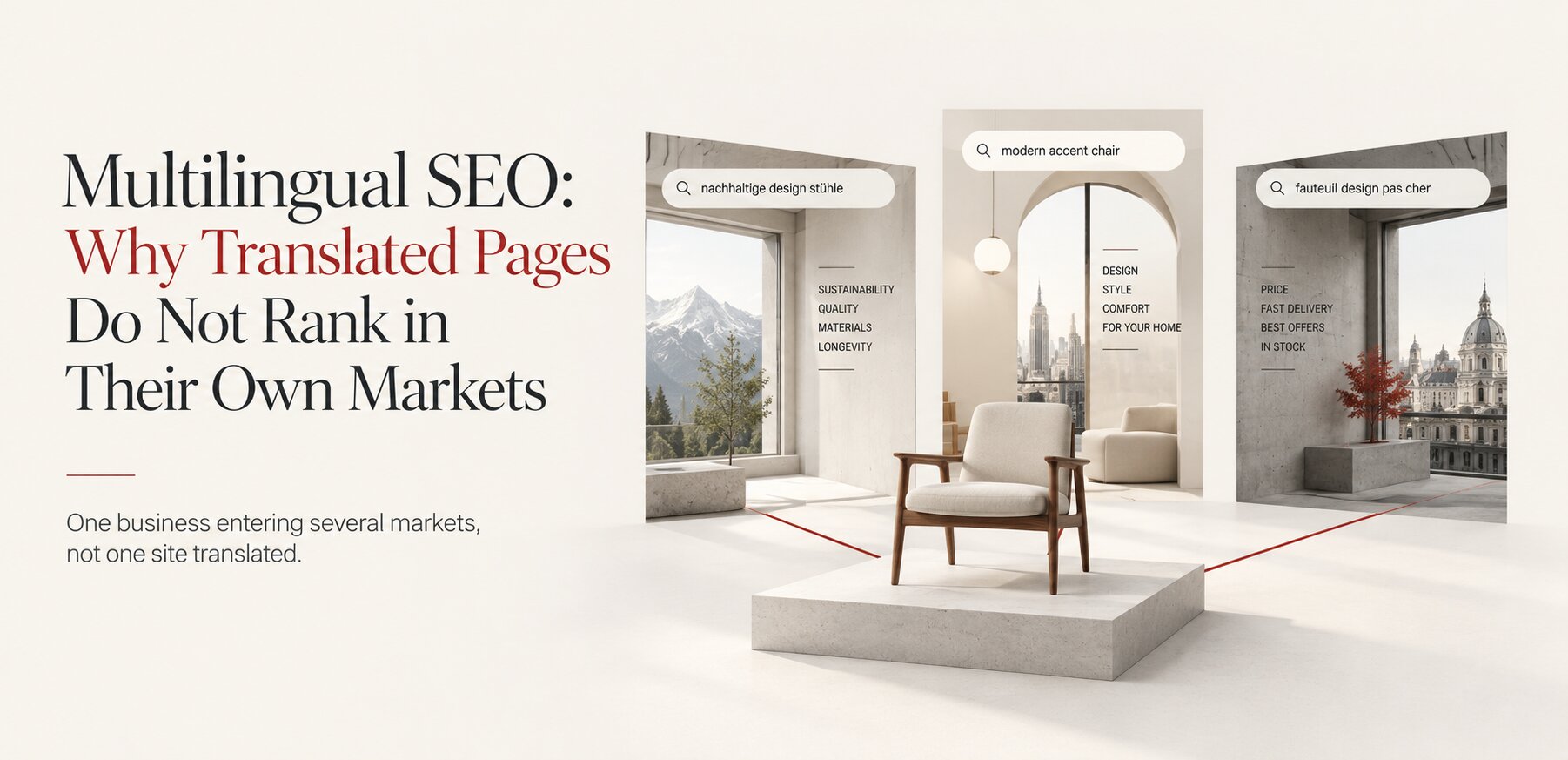
Multilingual SEO: Why Translated Pages Do Not Rank in Their Own Markets

-
16. 09. 2026
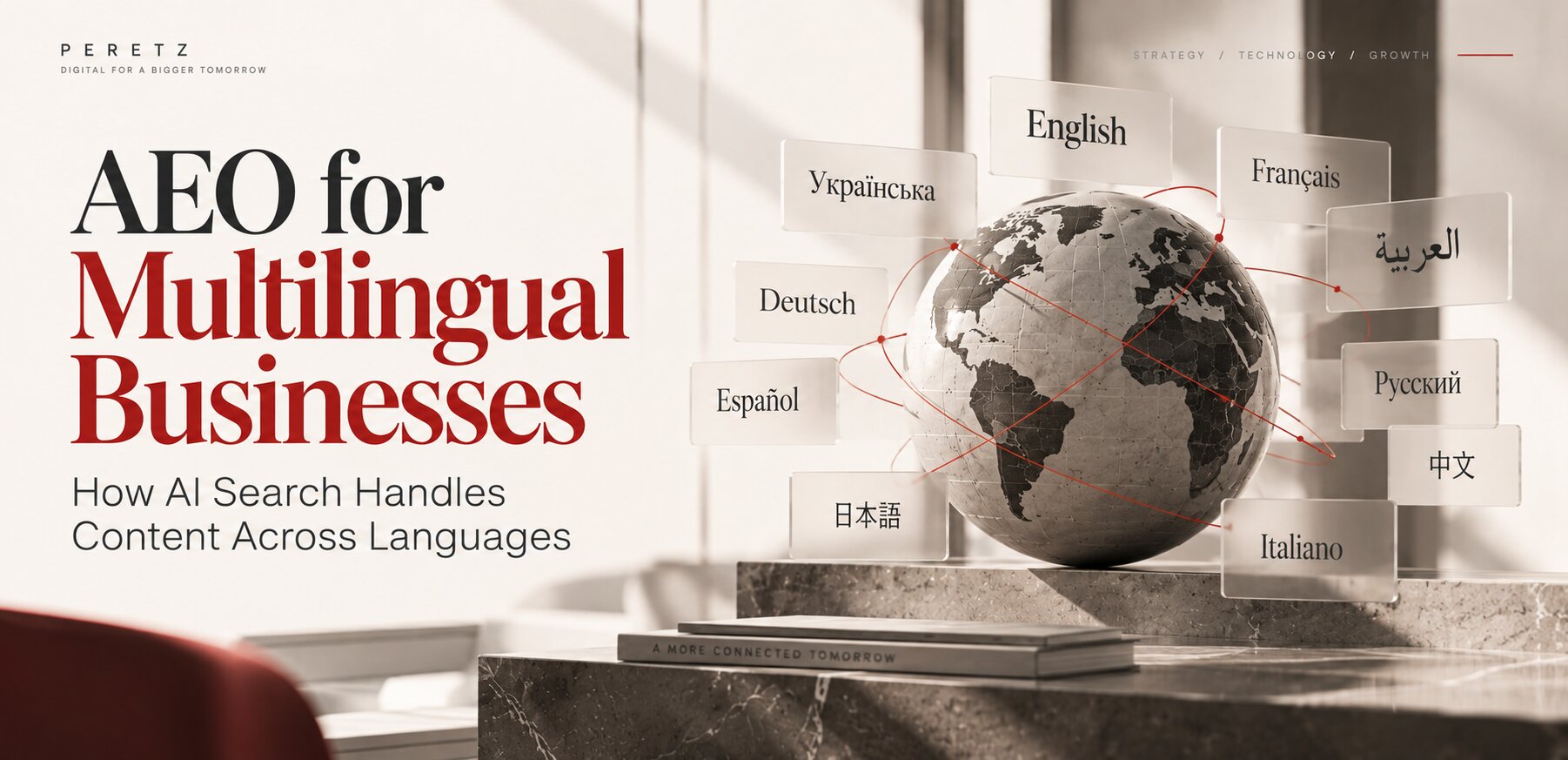
Multilingual AEO: Why Translation Isn't Enough for AI Search
-
09. 10. 2026
The Website Design Process Most Agencies Show You Is Wrong
-
10. 10. 2026
We Measured Nine Luxury Brand Websites. Here Is What Their Design Gets Right