


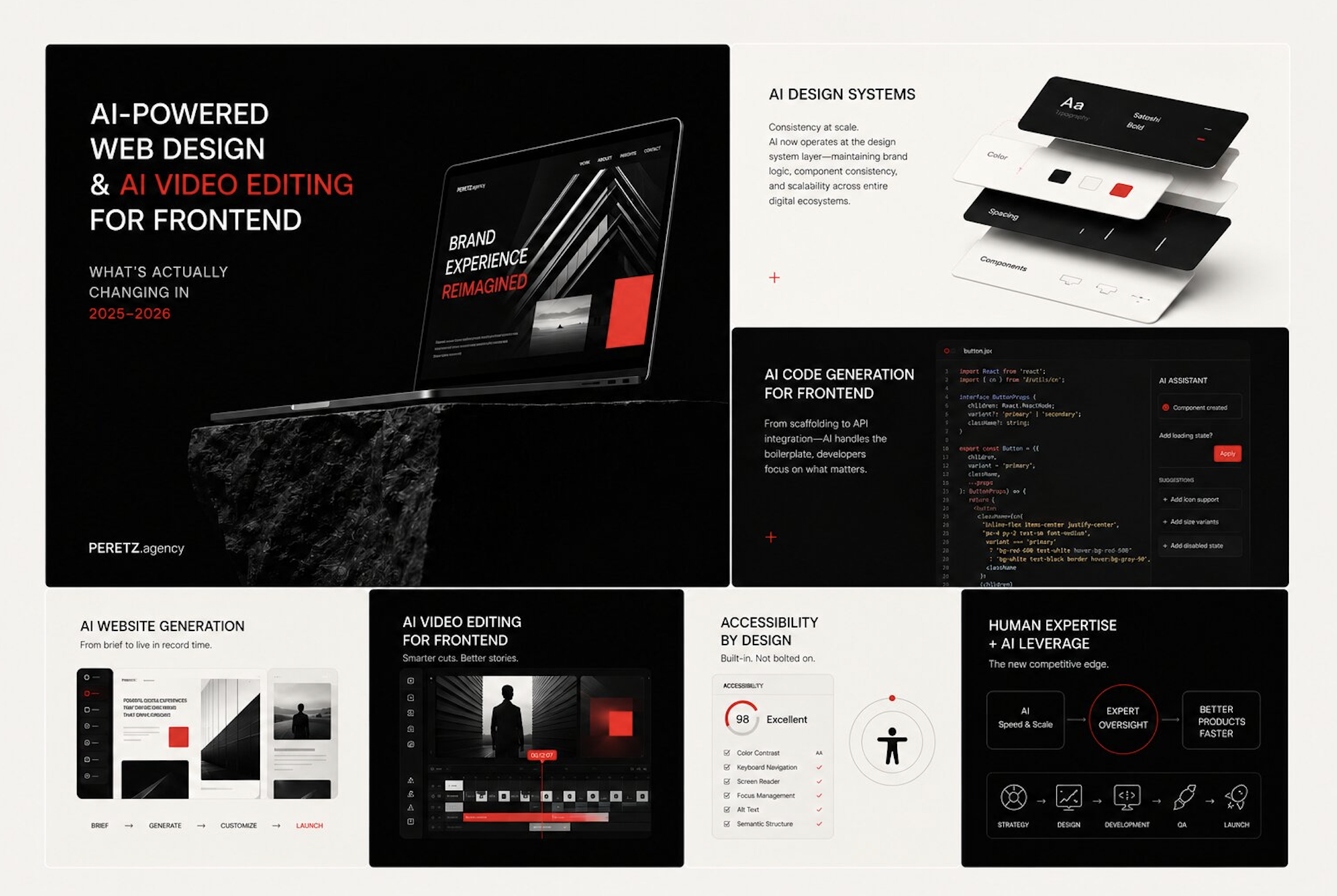
The Shift Has Already Happened — Most Studios Just Don't Know It Yet
The conversation around AI in web design spent most of 2023–2024 stuck in two extremes: either breathless hype about replacing developers, or defensive dismissal from agencies protecting the status quo. In 2025-2026, both camps have been overtaken by reality. AI has not replaced web design. It has fundamentally restructured what takes time, what takes talent, and what separates a good digital product from a forgettable one.
At PERETZ.agency, we work at the intersection of visual strategy, technology, and brand communication. What we've observed across our projects is not a revolution in the sci-fi sense — it's something more precise and more actionable: a redefinition of leverage. AI gives disciplined studios the ability to produce at a level that previously required three times the team or three times the timeline. The question is whether you're using that leverage strategically, or just using AI to produce mediocrity faster.
This article is for businesses, brand managers, and decision-makers who want to understand what's actually possible — and what's worth investing in — when it comes to AI-powered website creation and AI video editing for frontend in 2025.
AI in Web Design: What the Tools Can Actually Do Now
The generation of AI design tools available today operates on a different tier than the autocomplete widgets of two years ago. Platforms like Figma AI, Framer AI, and a growing stack of generative UI systems can now generate production-ready component structures from natural-language briefs, propose layout variations based on brand parameters, and adapt responsive structures intelligently across breakpoints.
More significantly, AI now operates effectively in the design system layer — not just at the level of individual pages. This is the critical distinction. Tools that generate isolated mockups are table stakes. The meaningful application of AI in web design involves:
- Generating consistent design tokens (color scales, typography systems, spacing grids) that maintain brand logic across dozens of component variants
- Automating component documentation so that large-scale design systems remain coherent as they scale
- Running visual regression testing to catch unintended UI drift when codebases evolve
- Accessibility auditing in real time — not as a post-launch checklist, but as an embedded constraint during the design and build phase
For enterprise clients and brands with complex digital ecosystems, these capabilities represent genuine cost compression at the infrastructure level. The front-end work that previously consumed weeks of senior developer time to maintain and synchronize can now be governed, in significant part, by AI-assisted tooling.
Generative UI and Code: The Frontend Development Dimension
On the development side, AI code generation has matured from a novelty into a professional workflow tool. GitHub Copilot, Cursor, Claude Code, and similar environments now handle substantial portions of component scaffolding, state management boilerplate, and API integration patterns — the categories of work that are necessary but not differentiating.
What this means in practice: a frontend developer working with modern AI tooling has a meaningfully higher ceiling on what they can execute within a sprint. The net effect for clients is more ambitious projects that remain on timeline, and fewer compromises driven by engineering bandwidth constraints.
The critical caveat — and this is where many agencies mislead their clients — is that AI-generated code is not production code by default. It requires senior engineering judgment to evaluate, refactor, and integrate safely. An AI coding tool in the hands of a junior developer who lacks the architectural experience to audit its output is a liability, not an asset. The tool amplifies existing expertise; it does not substitute for it.
PERETZ.agency applies AI code generation as a velocity multiplier under experienced oversight, not as a replacement for the human layer that makes digital products resilient and maintainable.
AI Video Editing for Frontend: The Most Underutilized Capability in 2025
If AI in web design is broadly understood, AI video editing for frontend applications remains largely underexplored by most agencies — and it is where some of the most significant visual differentiation is now possible.
The integration of video in web frontend has historically been constrained by two factors: production cost and file weight. Creating high-quality video content is expensive; serving it without degrading page performance is technically demanding. AI video tools are beginning to dissolve both constraints simultaneously.
AI-Generated Video Backgrounds and Hero Sections
Tools like Runway Gen-3, Kling AI, Sora, and Higgsfield now generate cinematic video sequences from text prompts or reference images with sufficient quality for use in web hero sections, ambient backgrounds, and editorial contexts. For a luxury brand or a product launch site, this means a custom-filmed video aesthetic is no longer gated behind a five-figure production budget. The visual language of premium — slow motion, atmospheric depth, refined color grading — is now accessible at the AI generation layer.
What remains human-critical is art direction. AI video tools produce what they are directed to produce. Without a clear visual brief, a defined color palette, and an understanding of how motion serves the brand narrative, they produce generic results that undermine rather than elevate the site. Prompt engineering for video generation is a genuine skill, not a button.
Adaptive and Personalized Video in the Browser
A more technically sophisticated application involves AI-driven video adaptation at the delivery layer. Modern frontend architectures can use AI inference to serve different video content variants based on user context — device class, scroll behavior, time of session, or geographic region. A site that serves a dense motion sequence to a high-bandwidth desktop user and a compressed static frame to a mobile user on LTE is no longer a complex engineering project — it's a configuration decision enabled by AI edge infrastructure.
For e-commerce, this kind of adaptive video delivery measurably impacts conversion. For brand communications, it ensures the intended visual experience actually reaches the intended audience regardless of device conditions.
AI-Assisted Video Post-Production for Web Assets
On the production side, AI post-processing tools have compressed the timeline for preparing video assets to web-ready specifications. Background removal, color grading normalization across multiple clips, automatic silence trimming, subtitle generation, and frame interpolation for smoother playback at lower bitrates — these tasks that once required dedicated post-production sessions can now be handled in automated pipelines.
For agencies running multiple client accounts with ongoing content production, this represents significant operational efficiency. For clients, it means faster time-to-publish on video-heavy digital campaigns.
AI and UX: Personalization That Goes Beyond A/B Testing
One of the more substantive capabilities emerging in AI-powered websites is dynamic UX personalization — not the rule-based conditional logic that passed for personalization in the 2010s, but machine-learning-driven adaptation that modifies content priority, navigation structure, and call-to-action framing based on inferred user intent.
This is particularly relevant for businesses with complex product catalogs, multi-segment audiences, or long conversion funnels. A site that surfaces different information architecture to a first-time visitor exploring options versus a returning visitor comparing specifications is not a hypothetical future state — it's a deployment decision available today through platforms like Mutiny, Webflow Logic, or custom implementations on headless CMS stacks.
The strategic implication is significant: the website stops being a static document and becomes a responsive system. The KPIs shift from "how many people visited the page" to "how effectively did the system serve the right content to the right person at the right moment."
The PERETZ.agency Position: Strategy Before Tooling
We are not an AI agency in the sense of selling AI as a product category. We are a web design and digital strategy studio that applies AI capabilities where they produce measurable results for clients — and declines to apply them where they produce artificial complexity for its own sake.
Our work with premium brands across automotive, luxury, fashion, and architecture sectors has consistently confirmed one principle: technology does not create brand authority. Clarity of vision, consistency of execution, and quality of craft create brand authority. AI accelerates and enhances the execution layer when that layer is already governed by rigorous strategy.
What AI has changed in our studio workflow:
- Iteration speed on design concepts — we explore significantly more variations before committing to a direction, which improves the quality of the final decision
- Frontend build velocity — complex interactive components that previously required extended development cycles are scaffolded faster, freeing senior engineering time for architecture and performance
- Video content production — AI-generated and AI-enhanced video assets have expanded what we can propose to clients with mid-range production budgets
- Data-informed UX — AI analytics tools surface behavioral patterns in user data that inform structural decisions more rapidly than traditional analysis cycles
What has not changed: the judgment required to synthesize all of the above into a digital product that serves a brand's specific objectives in a specific market at a specific moment. That is not an AI function. It is a human one.
What This Means If You're Planning a Website Project Now
If you are evaluating web design agencies or planning a significant digital investment in 2025, the right questions to ask are not "do you use AI?" Every serious studio does. The questions that actually differentiate:
- How does AI fit into your quality control process, and who reviews AI-generated output before it reaches production?
- Can you demonstrate examples where AI video integration enhanced the user experience rather than slowing the site?
- What is your approach to AI-generated design consistency across a brand system, not just a single page?
- How do you use AI to personalize user experience, and how do you measure whether it's working?
Agencies that cannot answer these concretely are either not actually using AI with sophistication, or using it as a cost reduction tool at the expense of quality. Both are legitimate concerns.
The Practical Bottom Line
AI website design tools and AI video editing for frontend are not coming — they are here, operating at production quality, and reshaping the competitive landscape for digital work. The gap between studios that have genuinely integrated these capabilities and those still operating on 2022 workflows will continue to widen.
For brands investing in their digital presence, this translates to a clear opportunity: work with studios that have developed real fluency with these tools, and hold them accountable to using that fluency in service of your specific business goals — not as a demonstration of technical novelty.
At PERETZ.agency, we build digital products for brands that cannot afford to be ordinary. If your next website project demands that standard, let's talk.
- Share
-

-

-

-

Related Reading
-
10. 07. 2023

LET’S STAND WITH UKRAINE TOGETHER!

-
16. 11. 2020

UX/UI Design in 2026: Why It Still Pays Off for Your Business
-
02. 12. 2020

Redesign of Sports Online Store Sport Discount
-
30. 11. 2020

The case of Laduchi
-
12. 03. 2021

In-House vs Outsourcing in 2026: What Business Owners Actually Need to Know
-
14. 02. 2021
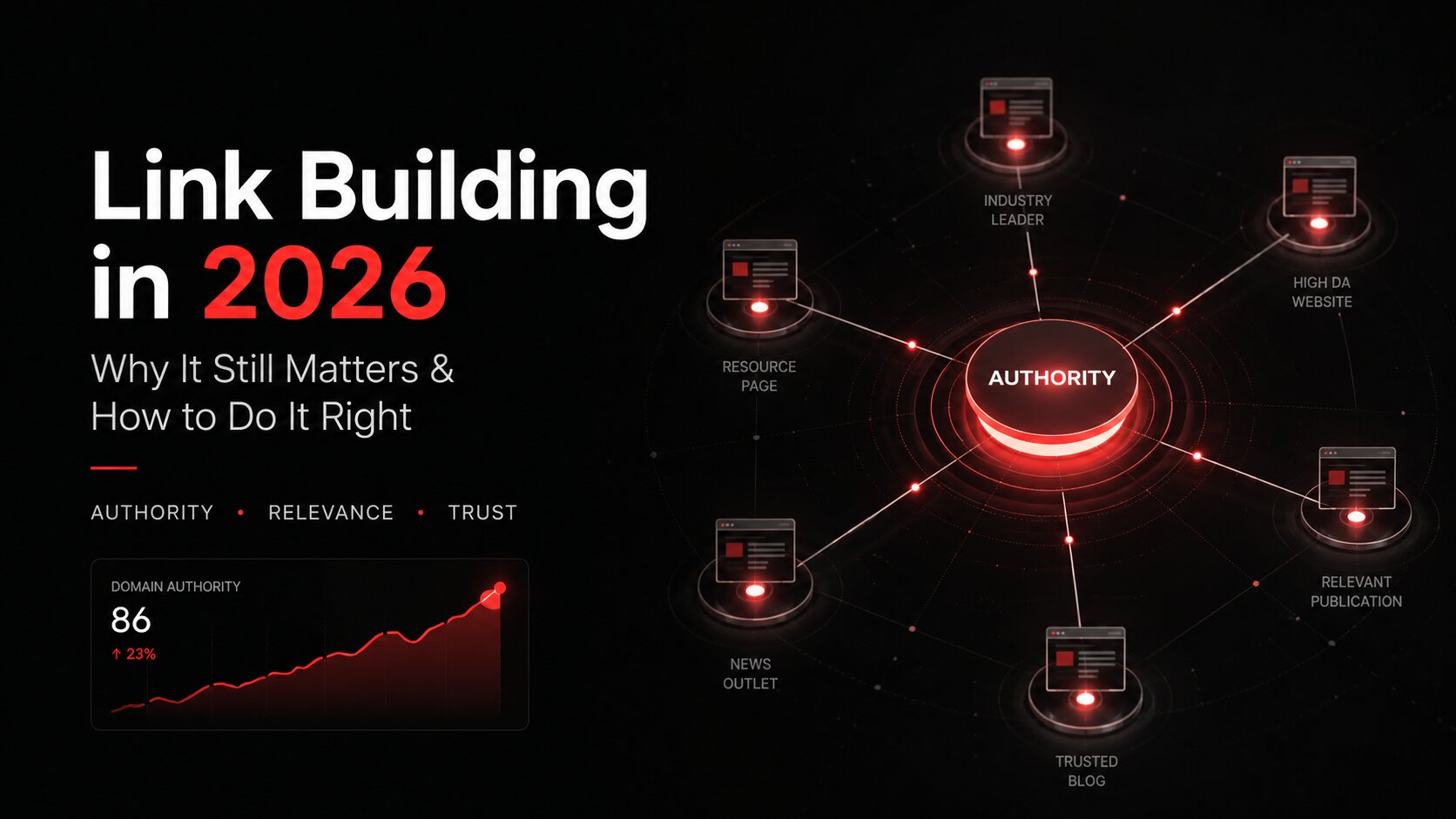
Link Building in 2026: Why It Still Matters and How to Do It Right
-
18. 06. 2026

Website Redesign Seattle | We Build Sites That Generate Leads
-
15. 06. 2026
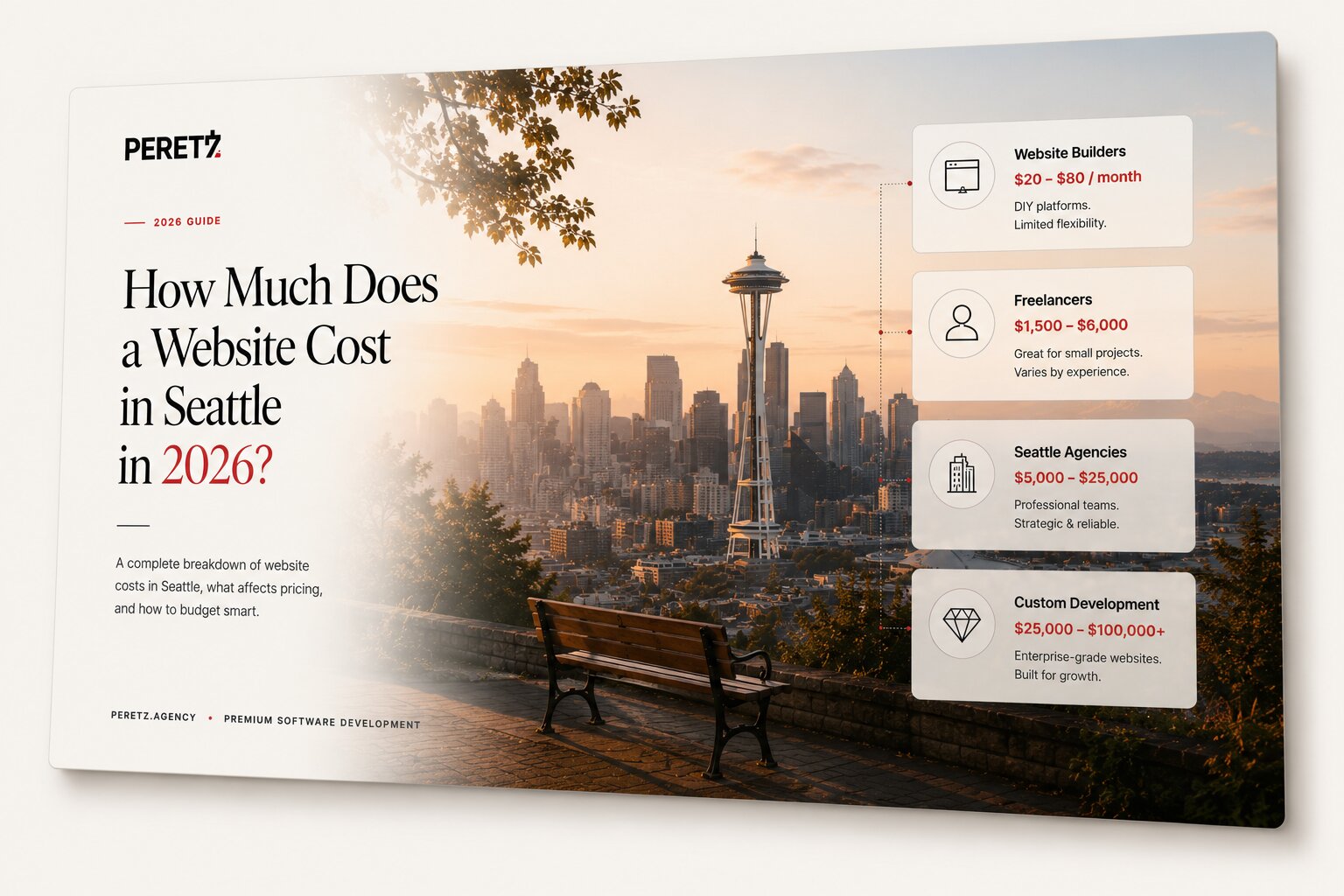
How Much Does a Website Cost in Seattle in 2026?
-
16. 03. 2021

Which Business Functions Should You Outsource in 2026?
-
06. 04. 2021

How to Rank Your Google Business Profile Higher in 2026 (Without Paying for Ads)
-
04. 07. 2026

What Working With a Kindergarten Taught Me About B2C Trust — And What Every Premium Brand Needs to Hear
-
07. 07. 2026

What Is AEO? Answer Engine Optimization Explained for Small Business in 2026